Pearson Edexcel · A-Level · English Literature
Course version: 9ET0 · Version from Sept 2015
Poetry – Section B: Specified Poetry Pre- or Post-1900 – Post-1900 – The…
Full specification wording
Component 3: Poetry – Section B: Specified Poetry Pre- or Post-1900 – Post-1900 – The Modernist Period – T S Eliot: Selected Poems (Faber, 2009): Gerontion
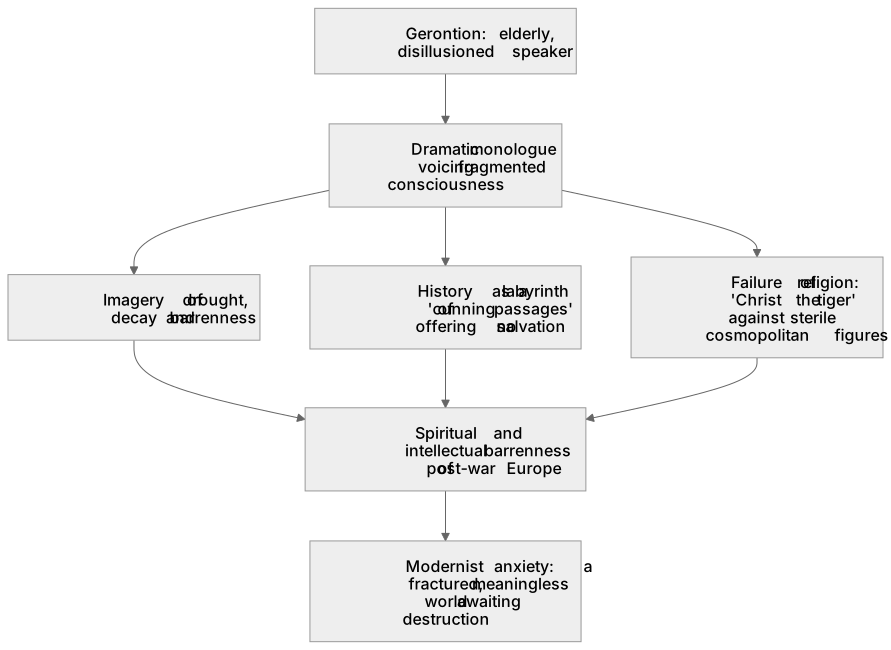
'Gerontion' is a complex dramatic monologue voiced by an elderly, disillusioned man who symbolises the spiritual exhaustion of post-World War I Europe.
Checked against the Pearson Edexcel 9ET0 specification (opens in a new tab) on .
- Point 1 of 7
- 4 key terms
Study notes
From the checked teaching notes for this specification point.
The idea
'Gerontion' is a complex dramatic monologue voiced by an elderly, disillusioned man who symbolises the spiritual exhaustion of post-World War I Europe. The poem is saturated with imagery of drought, decay, and barrenness, reflecting a world devoid of vitality and faith. Eliot uses the speaker's fragmented consciousness to critique the deceptive nature of history, portraying it as a labyrinth of 'cunning passages' that offers no salvation. The poem explores the failure of religion, contrasting the arrival of 'Christ the tiger' with sterile, cosmopolitan figures who consume but cannot create. Ultimately, the poem captures the Modernist anxiety of living in a fractured, meaningless world awaiting inevitable destruction, trapped in a dry brain.
What earns the marks
- Analyse the use of the dramatic monologue form to represent the collective consciousness of a decaying European civilisation.
- Evaluate the recurring motifs of dryness and blindness as symbols of spiritual and intellectual barrenness.
- Examine the personification of History as a deceptive, manipulative force that fails to provide moral guidance.
- Discuss the significance of the cosmopolitan characters, such as Mr Silvero and Hakagawa, as representations of a fragmented, rootless modern society.
Common mistakes and how to put them right
Assuming the speaker is T.S. Eliot himself.
Put it right: Identify Gerontion as a persona representing the broader cultural decay of the era.
Overlooking the religious allusions.
Put it right: Analyse the references to 'Christ the tiger' and communion to understand the poem's critique of modern spiritual emptiness.
Treating the poem's structure as disorganised.
Put it right: Explain how the fragmented, non-linear structure deliberately mirrors the chaotic, disjointed nature of modern history and memory.
Exam tips
- Link the imagery of the 'dry brain' and the 'decayed house' to the broader Modernist preoccupation with cultural sterility.
- Compare the passive, elderly speaker of 'Gerontion' with the paralyzed protagonist of 'Prufrock' to highlight Eliot's exploration of inaction.
- Examine the shifting tone, from passive reflection to apocalyptic fear, to demonstrate an understanding of the poem's emotional trajectory.
Try the lesson
The start of the Component 3: Poetry – Section B: Specified Poetry Pre- or Post-1900 – Post-1900 – The Modernist Period – T S Eliot: Selected Poems (Faber, 2009): Gerontion lesson, made from checked teaching notes for this specification point.
Have a go first
In the opening lines of T.S. Eliot's 'Gerontion', how does the speaker describe his past involvement in historical conflicts?
Listen
Gerontion' is a complex dramatic monologue voiced by an elderly, disillusioned man who symbolises the spiritual exhaustion of post-World War I Europe. The poem is saturated with imagery of drought, decay, and barrenness, reflecting a world devoid of vitality and faith. Eliot uses the speaker's fragmented consciousness to critique the deceptive nature of history, portraying it as a labyrinth of 'cunning passages' that offers no salvation. The poem explores the failure of religion, contrasting the arrival of 'Christ the tiger' with sterile, cosmopolitan figures who consume but cannot create. Ultimately, the poem captures the Modernist anxiety of living in a fractured, meaningless world awaiting inevitable destruction, trapped in a dry brain. A strong answer earns marks for these points. Analyse the use of the dramatic monologue form to represent the collective consciousness of a decaying European civilisation. Evaluate the recurring motifs of dryness and blindness as symbols of spiritual and intellectual barrenness. Examine the personification of History as a deceptive, manipulative force that fails to provide moral guidance. Discuss the significance of the cosmopolitan characters, such as Mr Silvero and Hakagawa, as representations of a fragmented, rootless modern society. A common slip: Assuming the speaker is T.S. Eliot himself. Instead, identify Gerontion as a persona representing the broader cultural decay of the era. Exam tip: Link the imagery of the 'dry brain' and the 'decayed house' to the broader Modernist preoccupation with cultural sterility.
See it
Key words
Say what each word means before you turn the card.
Spiritual barrenness
Try answering aloud or in your head before turning the card.
The deception of history
Try answering aloud or in your head before turning the card.
Ageing and decay
Try answering aloud or in your head before turning the card.
Cultural fragmentation
Try answering aloud or in your head before turning the card.
See every definition
- Spiritual barrenness
- A condition of dryness and blindness symbolising a lack of spiritual and intellectual vitality in a world devoid of faith.
- The deception of history
- The portrayal of history as a manipulative force of 'cunning passages' that offers no salvation or moral guidance.
- Ageing and decay
- The state of an elderly, disillusioned speaker whose decayed house and dry brain reflect a civilisation devoid of vitality.
- Cultural fragmentation
- The fractured, rootless modern society represented by cosmopolitan figures who consume but cannot create.
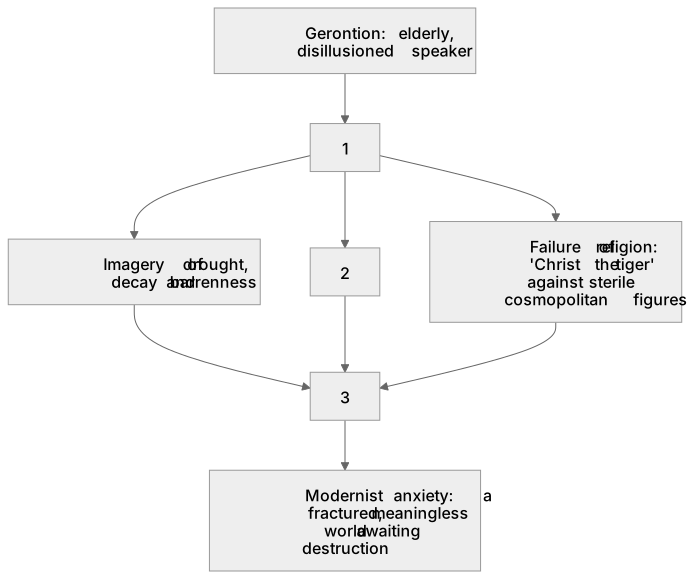
Label the diagram
Some boxes have lost their names. Pick the right name for each number.
1Box 1
2Box 2
3Box 3
There is more to this lesson
The full lesson goes on to check your understanding and help you earn the marks. Create a free account to carry on, with your progress saved.
A week of Premium from your first lesson · Then the free plan continues · No card, no charge
Test your understanding of Component 3: Poetry – Section B: Specified Poetry Pre- or Post-1900 – Post-1900 – The Modernist Period – T S Eliot: Selected Poems (Faber, 2009): Gerontion
Active recall beats re-reading. Take an instant quiz now to test what you’ve learned and lock it into long-term memory.
A week of Premium from your first lesson · Then the free plan continues · No card, no charge